More liveblogging from LAK13 conference – Wednesday afternoon, fourth session.
MOOCs

NB Reduced liveblogging in this session because I was presenting.
Doug Clow's Imaginatively-Titled Blog
Data science, research, analytics, technology development, and people

More liveblogging from LAK13 conference – Wednesday afternoon, fourth session.
NB Reduced liveblogging in this session because I was presenting.
More liveblogging from LAK13 conference – Wednesday afternoon, fourth session of the day.

More liveblogging from LAK13 conference – Wednesday morning, third session.

More liveblogging from LAK13 conference – Wednesday morning, second session.
Second session at LAK13. Ravi from Copenhagen is the chair.

Liveblog notes from LAK13 Learning Analytics Conference in Leuven, Belgium.
Erik Duval, General chair for LAK13 and local host, welcomes everyone.
The Vice-Rector of Science, Engineering and Technology at KU Leuven, Karen Maex, welcomes people and tells people a bit about KU Leuven. Been around since 1425, have a wide and deep historical and cultural heritage. Interdisciplinarity of LAK is good. Changes in communications patterns in society. Open, social models of learning. The first core business of a university is educating students to take part in a society that has changed so much.
Dan Suthers, Program chair for LAK13, welcomes everyone. He and Katrien thank authors and reviewers. Thanks the other chairs too. Theme of conference – Learning Analytics as a ‘middle space’. Very diverse ideas, now we’re moving to identify a core – though not too tightly. So keen on learning, and analytics. Conception of learning can be broad: no correct conception. Individuals as agents of learning, or something small groups do, or process of becoming a member of a community (LPP) where the community is the entity that’s changing. Different epistemologies of learning – moving information around, or it’s intersubjective meaning-making, or the process of becoming part of a community. We want to stay open to these questions. But we need to be explicit and clear about our own conception of what learning is. Interesting diversity and contributions – can be new technologies, or exploring their utility for informing our understanding of learning or the educational enterprise. The ‘middle space’, and ‘productive multivocality’. We do have many voices – different theoretical, methodological traditions; researchers, teachers, administrators, policy-makers, funders. Challenge for discourse. Risk of two extremes – it breaks up in to different discourses, or an ill-considered mish-mash of traditions. We need to find appropriate boundary objects, things that are meaningful in multiple traditions, the shared referent enables productive discourse. Asking everyone to seek this in the conference.
Nice chart of submission types over time – from 30ish in 2011, 60ish in 2012, >100 in 2013. Slides from Xavier. Acceptance rate going down: 63%, 39%, 28% this year. New and returning authors – most are new but some returning.
Katrien Verbert talks a bit about Conference Navigator. Has links to the full papers. Can add talks to your schedule, see who else is attending. They’ll use the data to develop visualisations. Introduces first keynote speaker: Marsha Lovett, from Carnegie Mellon University.

Liveblog notes from Tuesday morning 9 April at LAK13.
John’s the technical director of DataShop, with a team of people working on it.

Liveblog notes from Monday afternoon session at LAK13 – second part of the 1st International Workshop on Discourse-Centric Learning Analytics.

Liveblog notes from the first workshop at LAK13.
Shared wiki-like workspace at: bit.ly/dcla13notes
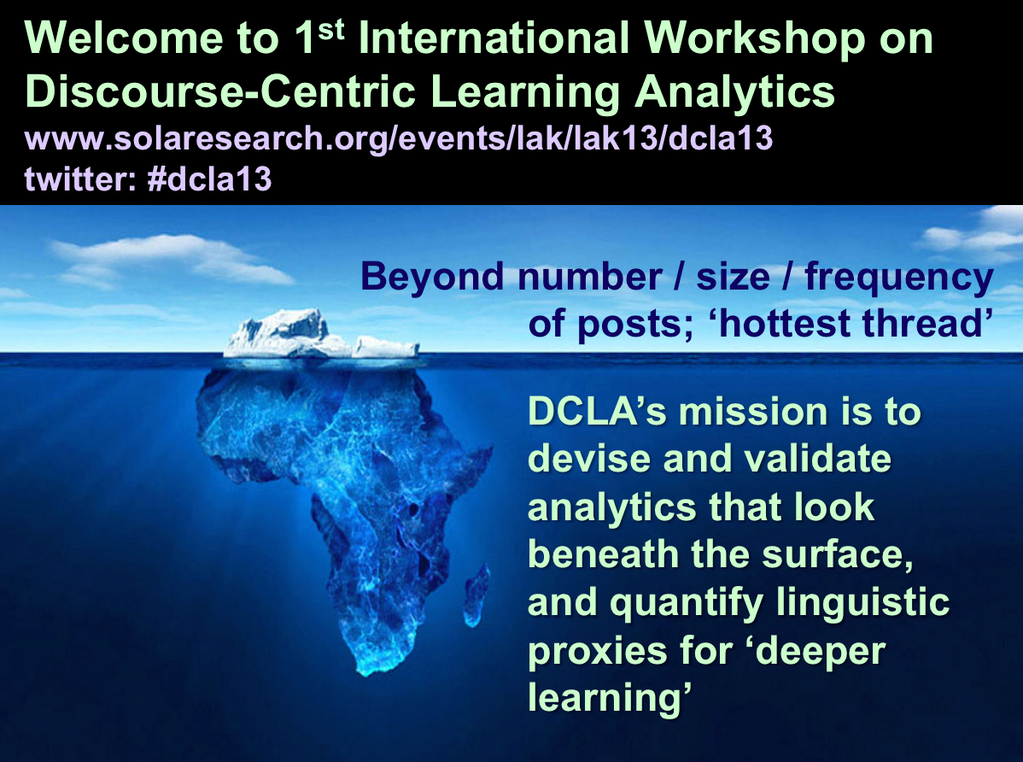
Continue reading “LAK13: Monday morning (discourse-centric learning analytics)”
Liveblog notes from a CALRG seminar given by Ilya Goldin, from the HCI Institute at Carnegie Mellon University, at the Open University, on 12 Feb 2013, entitled “Educational Data Mining for Technology-Aided Formative Assessment”.
His PhD research was a system to help peer review. Mike Sharples met him at the Alpine Rendez-Vous.

Postdoc at Carnegie Mellon; PhD at Pittsburgh.
Continue reading “Educational Data Mining for Technology-Aided Formative Assessment”
The first SoLAR Flare UK ran last week, and was a great success. There’s a really excellent organiser of information from and about it on the event page on the SoLAR website, including the slides presented.
Several others posted liveblog or similar notes, including Sheila MacNeill, who also links to Martin Hawksey’s archive of Twitter data from the #flareUK tag, and a video with some photos from the event, and Myles Danson who was particularly on top of the JISC CETIS Analytics series of publications that are coming out now. The plenary sessions were all captured on video and should be available for replay soon.
My estimable colleague Naomi Jeffery made PDF versions of my liveblog notes for easy reading on the Kindle, which is cool, and – even better – she’s passed them on in case anyone else would find them useful, so here they are:
Thanks Naomi!
 Doug Clow's Imaginatively-Titled Blog